

Welcome to “Acquired Taste”, a limited series from Fin Ideas, exploring the relationship between AI productivity and human taste.
As an AI company, our teams are always experimenting with new ways of working, discovering what’s possible in this era. Fin Ideas is where they come to speak about their findings and document their processes. Recently, as AI tools have grown in sophistication and embedded themselves deeper in our workflows, commonalities have emerged across disciplines. While Agents can handle more than ever before, their abundance of output can quickly feel overwhelming. When ability is no longer the bottleneck, intent and judgement become important gatekeepers, distinguishing adequacy from excellence.
Over the coming weeks, we’ll bring you stories from across our organization that explore what it means to produce truly great work with AI, the value of human taste, and how it can be maintained in a world of abundance.
At Intercom, how we design and build software is unrecognizable from 12 months ago. Our engineering team is already at the point where 90% of pull requests are authored by Claude Code, part of an internal initiative called 2x, where the explicit goal is to double productivity using AI.
For designers, there are commonalities, but the picture is different. We’re able to do significantly more than before, and we’re doing it faster. As my colleagues Thom and Emmet described previously, we’re using AI to rapidly prototype and build out the roadmap, generating working code from rough ideas so we can test and iterate sooner. We’re also taking more ownership of the front end. But this is only the start. The deeper shift isn’t just speed, it’s where design effort sits.
As the rate of execution accelerates, the role of design becomes sharper. Agents can generate artefacts, but they cannot decide which problems matter, set intent, resolve trade-offs, or hold the bar for quality. Our craft shifts with that reality. This means less time refining pixels and more time defining systems, tests, and guardrails that preserve quality and coherence at scale.
Agents will own the middle, the build. Design’s value concentrates at the edges, deciding what to build and then determining whether the output is good enough.
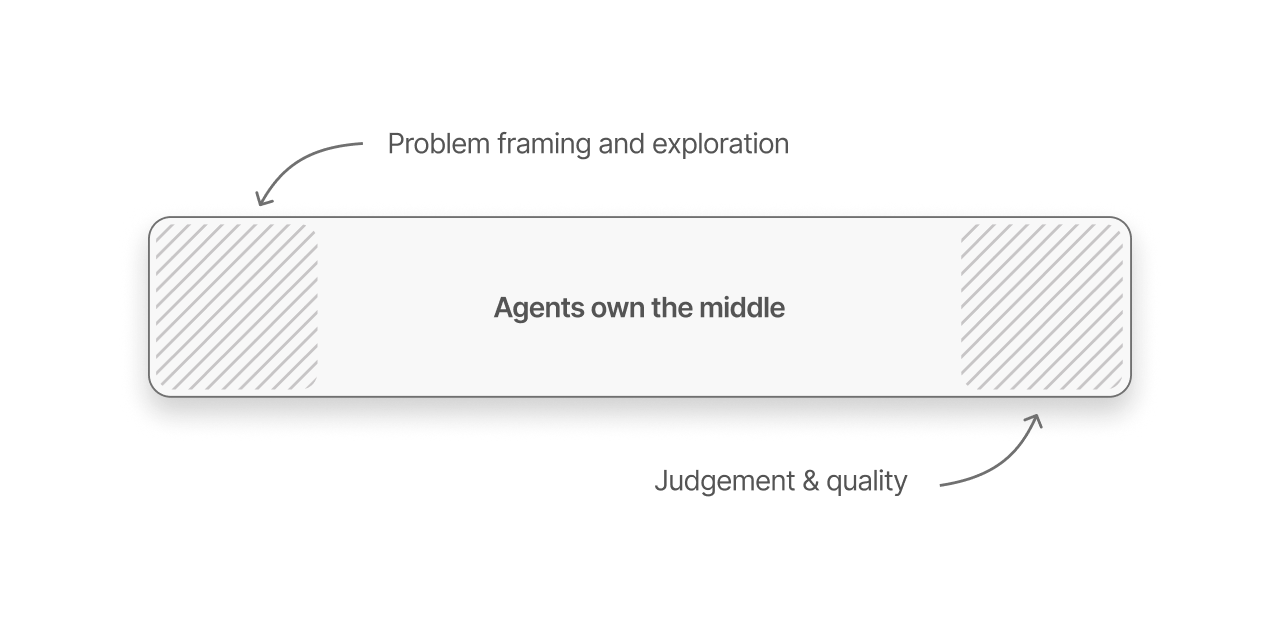
Design’s value shifts to the edges: shaping the roadmap and owning quality.
What’s happening
Intercom isn’t the only organization moving faster. Companies like Spotify and Anthropic are also adopting AI-only engineering workflows. And models keep getting better. A raft of updated LLMs landed between late 2025 and early 2026 with stronger reasoning, larger context windows, and better coding ability. Andrej Karpathy, one of the most influential voices in the field, captures the shift that’s underway:

Engineering productivity is accelerating; it won’t stop at 2x, and that has a profound impact on how we design.
In conventional product development, there’s a natural rhythm that allows for deep thinking. The time it takes to write code creates built-in pauses for reflection and planning. Design and PM use those pauses to iterate, test, and refine. That rhythm could disappear as multiple Agents enable teams to dramatically increase the speed of production.
Thinking time won’t just shrink, it will change shape entirely. Instead of one stream of work with natural gaps, you’d be evaluating outputs from parallel workstreams at the same time. Less like working with a team, more like managing a hundred people who’ve all been given marching orders at once.
But speed is only part of the story. Early AI tools could answer general questions about design or code, but they had no awareness of what you were actually building. The latest tools operate inside your codebase, with access to your components, patterns, and constraints. And that changes everything. Working with AI within a shared context, you stop asking generic questions and start directing specific outcomes. That’s why our designers are now primarily working in code. By doing so, we can go deeper into the problem space earlier and minimize the gap between design intent and reality.
LLMs are obviously great at writing code at pace. But they’re not great at knowing what to build next, or if the result actually works for users. That’s where design comes in. The teams that adapt fastest and harness these tools will have more influence over what gets built than ever before.
What we’ll do differently
When code is cheap and fast, everyone moves upstream. The boundaries between PM, design and engineering will continue to blur. What design brings to that space is distinct: user understanding, experience quality, and the ability to make ideas tangible. A working prototype is worth more than any strategy doc, and AI makes it faster than ever to go from a rough idea to something tangible people can react to. As design, we create compelling visions for what’s possible, building momentum that pulls the whole team forward.
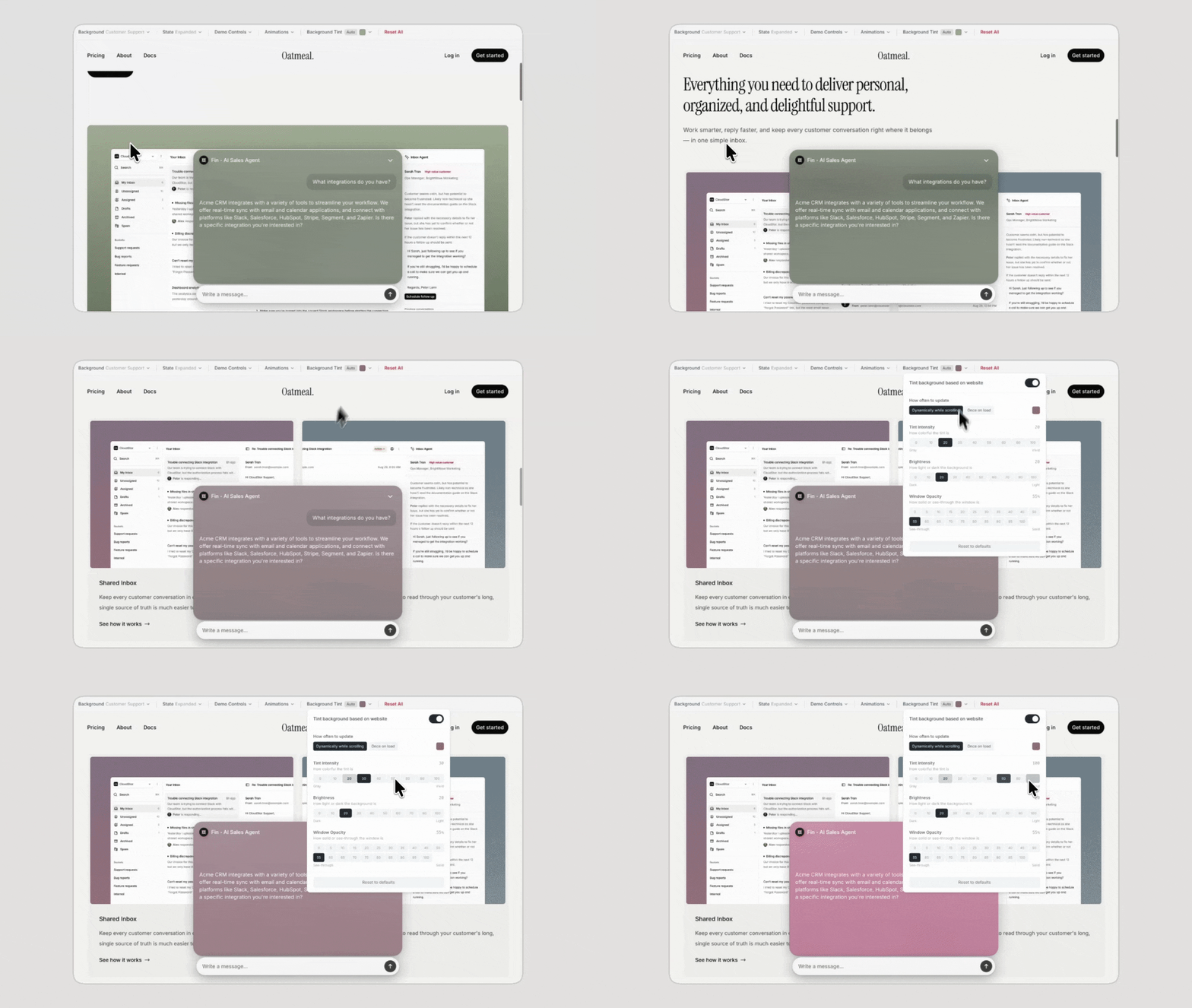
An example by Daria V, a designer on our team, who used Claude Code to prototype with fine-grained controls for a background tint feature to a level of detail that would normally take weeks of back-and-forth with engineering.
Our relationship with quality changes too. Definitive handoffs and perfection on the first pass matter less, instead we focus on the speed and rigour of the iteration loop. The bar for craft doesn’t drop, but instead of spending days polishing a small number of iterations, we explore a wide range of options, get fast feedback, and converge on the right solution sooner.
However, speed without direction is just noise. The old pauses in the development cycle happened by accident, the new ones need to be deliberate. As the pace of output increases, the ability to quickly evaluate becomes the most valuable skill in the process. That means tighter briefs at the start, fast review cycles, and clear criteria for what good looks like. It’s critical that we create the space to ensure what’s created is ultimately worth shipping. The faster Agents move, the more valuable design judgement will become.
There’s something else worth noting. Working with AI isn’t just faster, it’s different. These models don’t approach problems the way a colleague would – they make connections across domains and challenge assumptions you didn’t know you were making. The back-and-forth often reframes the problem entirely, giving us new input into the design process.
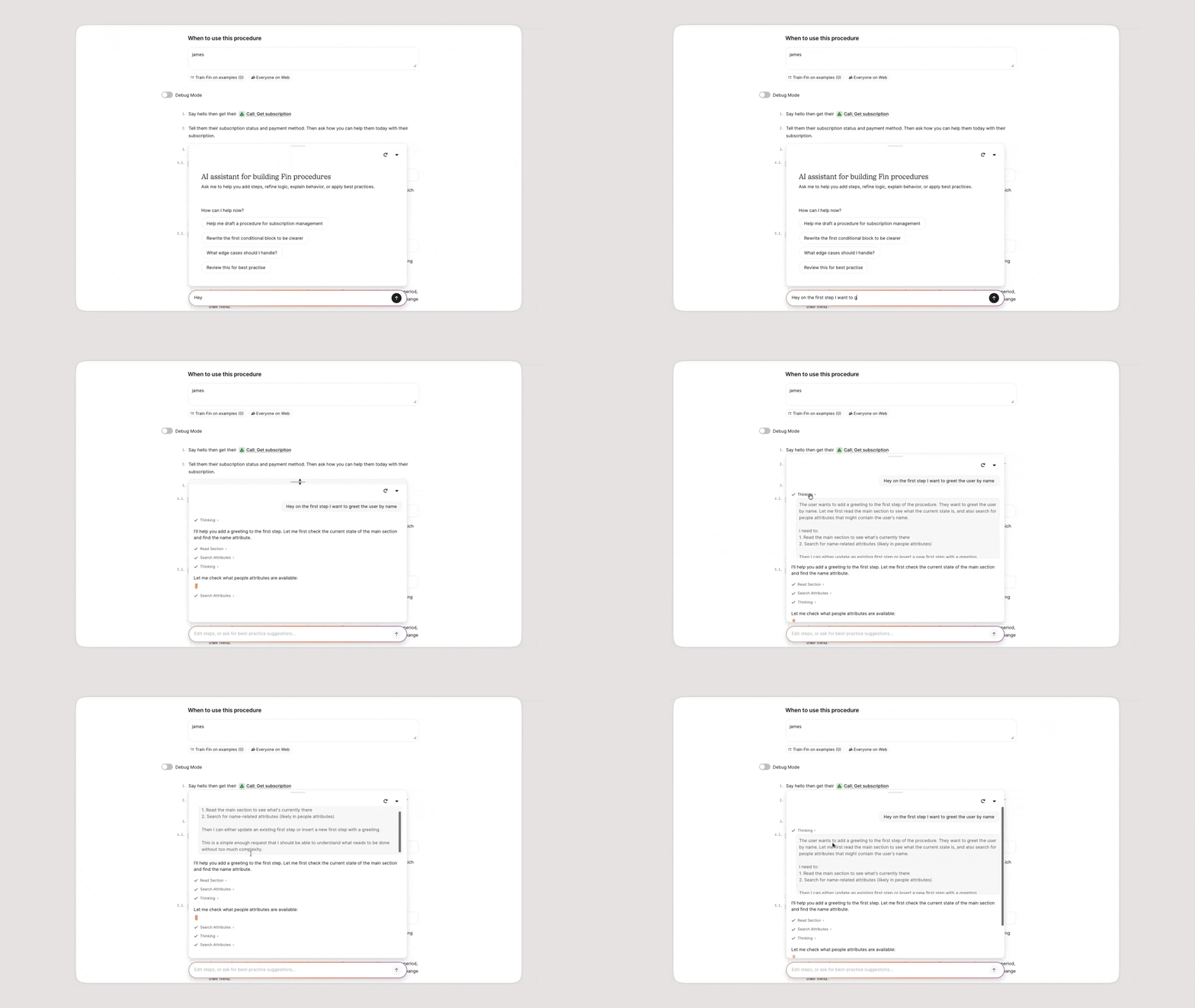
A prototype of an agentic UI by designer James Cash. Built within production environments with live data to learn from real-world use. AI helps explore possibilities, but nuance and edge cases only show up in the wild.
For design leaders, that means moving from gatekeeper to orchestrator. When anyone in the organization can design, our value comes from setting the standard for what good looks like and holding that quality bar. By doing so, we raise the capability of everyone around us.
What this looks like in practice
These shifts are already underway internally. If last year was about experimentation, we are now focused on scaling what works and building a consistent level of AI fluency across the team through a series of deliberate changes:
Promoting AI fluency
We run structured training, shared rituals, and focused exploration time so every designer can use these tools confidently. Demo sessions, office hours, and deliberate experimentation are becoming part of our rhythm.Challenging orthodoxies
We are no longer defaulting to Figma, which is increasingly being used more like a whiteboard. Starting in code changes removes some abstraction and forces earlier decisions about structure and states while surfacing edge cases. It also accelerates iteration. When the cost of generating functional UI approaches zero, the value shifts to intent and judgment.Cross-functional collaboration
Designers work closely with engineers and product managers to share tooling patterns and workflows. Fluency cannot sit in silos. The 2x initiative explicitly expects non-engineers to contribute directly to the codebase. Our design system work is how we make that possible at scale. It becomes a shared resource that raises the quality bar across the organization.Design system as agentic infrastructure
In a world where Agents write most of the code, design systems become the infrastructure that protects quality. Components, libraries and guidelines are the foundation that Agents and teams build on top of. The better the system, the better everything produced. Strong systems allow quality to scale without adding review overhead. The Surge design system playground is an example that enables designers to prototype directly with production components.From makers to curators
Code generation can scale but human attention cannot. As Agents explore widely, our role becomes more curatorial. We shape trajectories, recognise patterns across options, and deliberately converge where it matters. Exploration expands, but convergence becomes the craft.
The Surge design system playground enables designers to prototype using production components
What still matters
Not everything changes. Some things become more important.
Critical thinking, judgment, and taste sit at the top of that list. AI can generate a hundred variations of a solution. It cannot tell you which one is right. That decision still depends on context, experience, and an understanding of trade-offs that models do not truly possess. Knowing when something is good enough, and when it needs another pass, becomes more valuable as production speed increases.
Craft still matters too, but how we define it is changing. It’s the small decisions that make something feel intentional and considered rather than procedural or AI-generated. Users won’t care how something was made. They’ll care whether it feels right. Our job is making sure it does.
The tools have changed, and the speed has changed. But the core of what makes design valuable has not. We are still the people who look at what exists and see what it could be, and decide whether it should.
The difference now is that the distance between seeing it and shipping it has never been shorter. That’s not a threat to design. It’s the best thing that’s ever happened to it.

Thanks super practical