

The predicament that the SaaS industry is in is not that surprising. No, we didn’t quite realize that AI was going to commodify code. But we did know that in the face of disruption, a force not new to tech in any way, the only way to have a place in the future is to destroy your past. The failure of essentially all software companies to do so in the age of agents has left them in an extra sticky spot now that the stock market is less excited about conventional software.
In this post, I’m going to offer Intercom, the company I run, as a case study to help me explain how SaaS companies can be saved, and share the things we did, starting three years ago, to find relevance in this new world. We’ve found ourselves being referred to as the poster-child for success as a late stage SaaS company in AI, and I’d like to first share some numbers and background context to help you understand why that is.
Three years ago, our future was looking pretty bleak. I jumped back into the CEO role after a two year hiatus while sick, when we were heading quickly towards negative growth. All SaaS growth rates fell as the ZIRP days waned, and ours fell extra hard due to an unfocused business strategy that led to poor product market fit. A month later, ChatGPT was announced and we all began our collective, gradual, and still ongoing journey to try to understand what it all means. I’ll give you the simplified meme version of the story first—“step 1: AI; step 2: ????; step 3: profit”—because I’ll be explaining the how shortly thereafter. But, in summary, we launched our new service agent, Fin, in the summer of 2023, and our business began to violently recover thereafter.
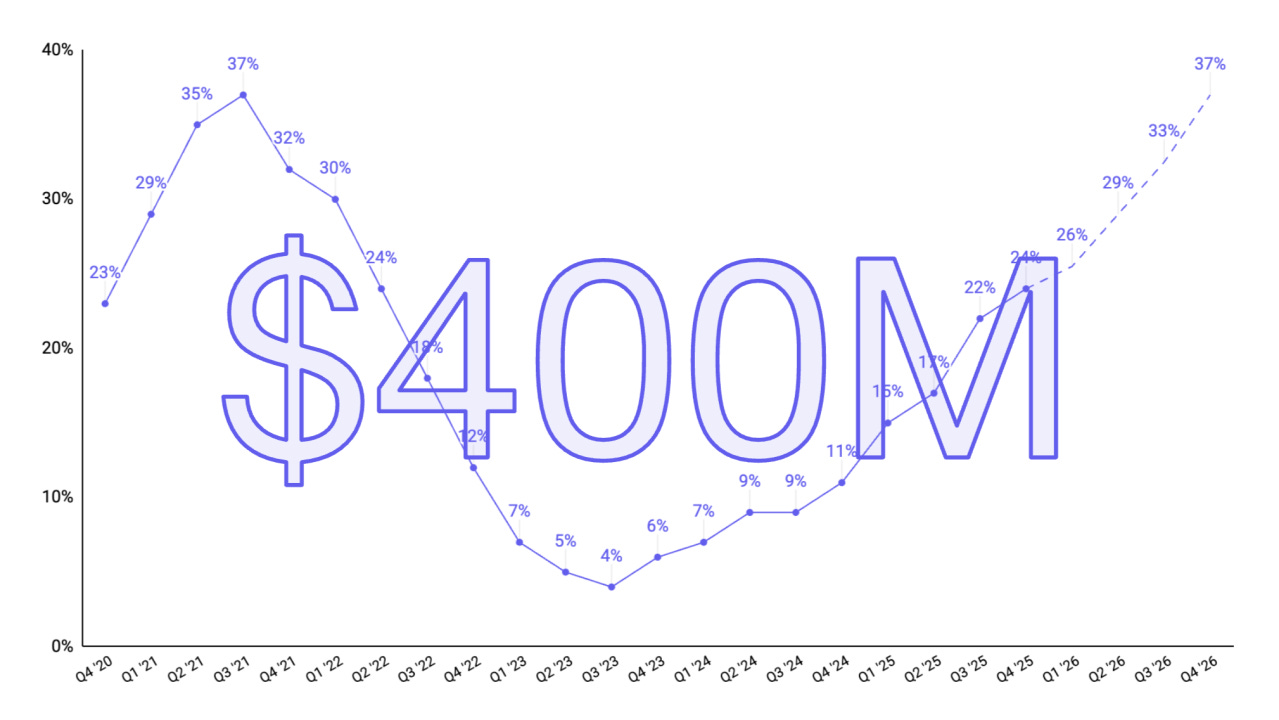
We’re now at $400M ARR overall, with Fin about to pass $100M. But most remarkably, while growth rates amongst our peers have continued their decline, we’ve doubled our overall growth rate each year for the past two years, and are now on our way to being the fastest growing, large software company (per our knowledge), private or public, in the world. This is structural acceleration that comes from the aggregate of two businesses, one being the hypergrowth business Fin growing at ~3.5X and about to be half of our revenue early next year.
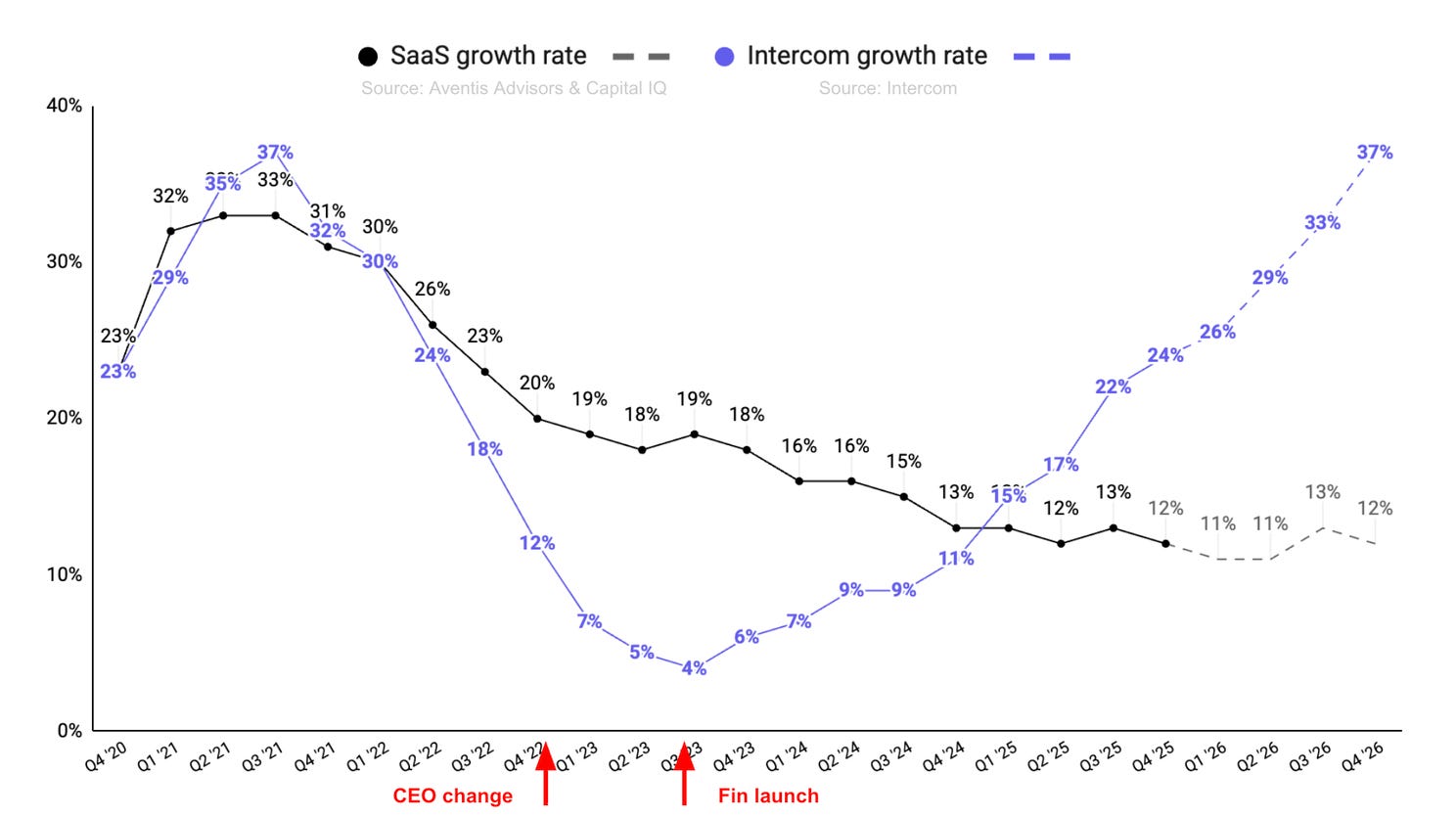
For anyone in this industry, particularly if you’ve been in it for a decade or more, you’ll know that the chart above has essentially never been seen before. It’s so strange, it’s been hard for us all to believe. For everyone else, please take my word for it that what just happened at Intercom is kind of insane.
Anyway, I want to talk about destroying the past, but before that, some acknowledgements. We had a lot in our favor that got us out ahead of the journey that everyone else must now take. For one, we were desperate for new growth. We were performing far worse than average, we had less to lose. That makes hard decisions less scary. Beyond that, we had a CEO change. It’s far easier for someone new to come in and say they don’t like how the last guy did things and rip everything up. CEOs who’ve been in seat the whole time have to wrestle with their egos and blind spots to see that great change to their own plans is the only way. And finally, we were in the right place at the right time. Conventional service software was so obviously going to be decimated by agents, and we had been building AI bots with our own AI team for years. We didn’t have a standing start.
But we made plenty of strong and brave decisions as well, the essence of which I’m asking you to do now too: We turned our back on everything we held dear. We actively, literally killed our old business. We followed the only path out of this mess, which is actual creative destruction.
In a world of agent abundance, the workflow tools sold by our industry are clearly far less important, and also must drastically change. Agents don’t need workflow tools, and the humans working with the agents need different tools too. The tough pill you must swallow is that if you can’t become an agent company, your CRUD app business has a diminishing future. But what about cannibalization? “I’ll damage the revenue from my workflow tools if I pump my customer base with agents which don’t need those tools.” YES, YOU WILL. And if you don’t, someone else will gladly oblige. This is why we call it creative destruction.
At Intercom, we destroyed so many things, big and small. We ripped up our old values, and created new, disruptive ones which we then hired and fired against to drive the behavior we needed in this new world. We rewrote our mission to focus on our agent goals. We changed our targets to Fin revenue. We switched up our board, removing “mature and experienced” leaders for startup founders. We moved our R&D focus to be nearly 80% on Fin, while that business was still a single digit percent of our revenue. We created a whole new brand, and a separate site, with a separate $1M .ai domain—ouch—and drove 100% of our paid traffic to it. Every bit of marketing effort said Fin Fin Fin, not Intercom. And was risky, big picture brand and positioning marketing to hopefully pay off later vs incremental performance marketing to definitely pay off that quarter. Again, while Fin was a single digit percent of our revenue. All because we needed the market to give us a new look for a new category. We aggressively promoted and compensated our AI team above others. We grew it from ~6 to ~60 people in 3 years with real, Phd level AI scientists and researchers. We built out our own AI, and trained our own foundational models. (More on that soon.)
This slow work behind-the-scenes hurts when your nearly 30k customers are asking for new features. Almost all product launches were about Fin. All podcast interviews, all events. We announced that we would spend $100M of our cash reserves—of course, a paltry figure now —back when many were convinced AI was pure hype. We actively managed our entire customer base to a new, risky pricing model—we invented “outcome based pricing” that everyone in the agent space now talks about—that focused monetization on our helpdesk and agent combo, while reducing pricing for everything else, killing ~$60M ARR in the process.
We did not hold back on the creative destruction. And that really is the only idea I’m trying to sell here. We deserted our past to make way for our future.
To my peers in software: This shit is insanely hard. (And if it’s not hard it’s unlikely you’re doing it right.) The shift from on-prem to cloud wrecked many companies, but the change was not nearly as fast. And while it proved quite difficult for the previous generation to adapt quickly enough to keep up with my own, the shift in approach, skillset, go-to-market, and more was not nearly as dramatic. But, still, this shift is possible. Little, old, left-for-dead 15 year old Intercom did it. You can do it too! You have the brand, the customer base, the cashflows, and the access to debt. And you have the workflow tools that can be adapted for their new future for use alongside your agents too. Most of you have started moving towards this world already, but in contrast to what most AI-pilled technologists believe, I don’t think it’s too late if you haven’t! The tech is moving so fast, but customer adoption in many places will remain slow. Many large software companies will die and be bought for parts, but many will survive. As someone who’s been grinding alongside you for decades in this industry, I know how scary this time is. I want you to survive it and win. All it will take is destroying everything you love. Good luck.
