

A physical store has a hard ceiling – literally.
You can pack it to the rafters, but ultimately you can only fit a limited number of SKUs in a brick-and-mortar building. What ends up on the shop floor has to be curated, and knowledgeable staff do the rest: asking customers questions, learning their preferences, and providing suggestions. A limited catalog is the tax you pay for a good experience.
When commerce moved online, that limitation disappeared. Suddenly, you could host every SKU, think ASOS or Amazon. But this solution created another problem: the paradox of choice. Faced with everything, customers struggle to find anything. We presented them with a vast database and only gave them rudimentary tools, like filters and search bars, to explore it.
Seventy percent of online shopping carts are abandoned and the average online store converts at just 1.6–3% compared to brick-and-mortar’s conversion rates of up to 40%. A 3% conversion rate means 97% of people who were interested enough to visit left without buying. We’ve normalized this performance and called it a successful funnel. It’s time we ask for more.
What’s changed
The history of technology follows a pattern: great products emerge when an underlying scientific breakthrough enables a novel user interaction – one that wasn’t possible before and that feels, in retrospect, like the obvious thing to build.
Every major leap in computing tends to move in the same direction: make the interface less abstract and more human. We started with punch cards, powerful for data storage but illegible to humans. Then came the command line, giving us readable text, but you had to learn a language. Followed by the graphical user interface with its mouse and icons. And touchscreens, letting you reach through the glass and push things directly.
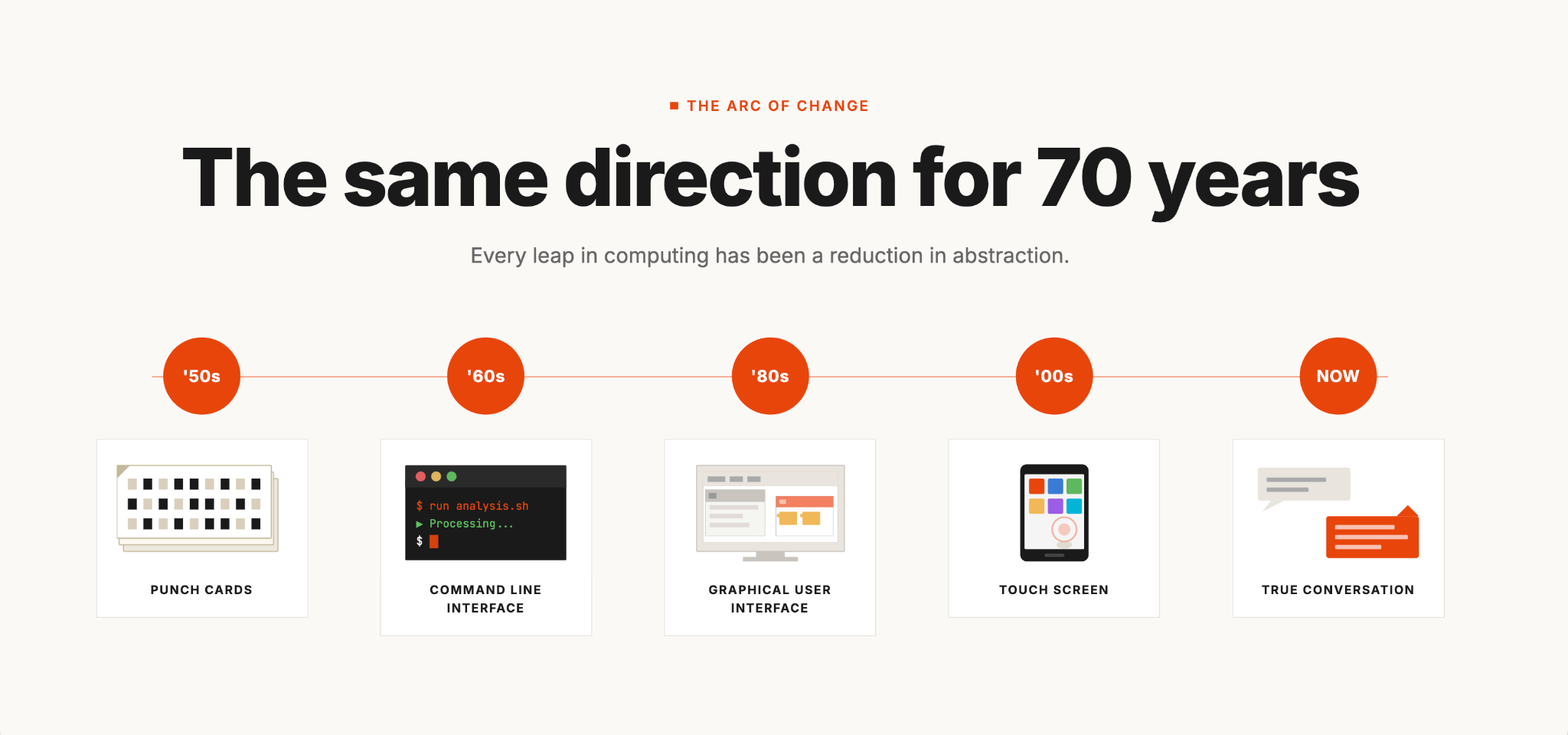
Each brought us a step closer to how we naturally interact with the world. Conversational AI is the next great leap forward.
And now that it’s here we can ask ourselves: what is the ideal UI and interface for ecommerce? And how can AI help us get there?
From a search bar to a sales assistant
Walk into a high-end boutique and the staff want to understand you. You mention an outdoor wedding in Spain, they ask a few smart questions, and within minutes they know more about what you need than any filter sidebar ever could. Conversational AI makes this level of service possible online and retailers are already looking for ways to provide it.
People seem to understand this intuitively. Our AI Agent Fin was initially designed for service, but we observed many of our customers using it to build their own Agents for ecommerce.
WHOOP, the fitness wearables company, is one example. During browsing, their customers had questions like: “Which membership is right for me?” or “How often do I need to charge my WHOOP?” If someone spoke to the inside sales team, they were twice as likely to convert, but there weren’t enough reps, and customers could wait more than 10 hours for a reply.
With a product launch on the line and an anticipated spike in conversations, they deployed Fin to the “Join” page – the final step before purchase. Fin resolved 84% of inbound questions, helping the team drive a 130% increase in attributable sales.
WHOOP and other retailers validated the need for an Agent that can provide personalized shopping.
What we built
We built a specific ecommerce role for Fin so it can connect to your Shopify store and answer product questions, help buyers find what they’re looking for, and handle support all in one conversation.
But to deliver a sophisticated shopping Agent, we had to rethink how AI reads product catalogs.
Traditional search – including most “AI-powered” search – flattens product data into text and loses everything that makes commerce structured. Pricing, variants, availability, and category hierarchies are all reduced to tokens.
Fin decomposes every query into semantic intent (what you mean) and hard constraints (what’s non-negotiable). When you say “I need a dress for under $200, nothing black,” the price ceiling and color exclusion are hard stops. That way, you don’t get beautiful $400 near-misses crowding out the right answer.
Its ability to reason across a product catalog beats out any attribute map. An early customer uploaded a selfie and asked what foundation color she should buy. Without the data to map pixel colors to products, Fin instead used general knowledge to identify her skin tone and undertone and search the catalog for suitable products.
Fin’s decision-making is also determined by relevant context. It tracks where you are on the site and in the buying process: exploring, narrowing, or deciding, and shifts its behavior accordingly. It knows when to show you related options, dive into detail, or close the sale.
The result is something closer to a knowledgeable sales assistant than a search bar.
What comes next
It would be an oversimplification to say conversational UI will replace shopping entirely. Technology doesn’t work that way. The new thing arrives but the old thing doesn’t immediately disappear – banks still run 50-year-old COBOL.
Conversational AI is excellent for some things, like exploration and moments of uncertainty. But traditional UI still has a place – nobody wants to fill out a delivery form through a chatbot.
The interesting design work is matching the mode to the moment, and to the shopper. Some people will always want to shop on their own.
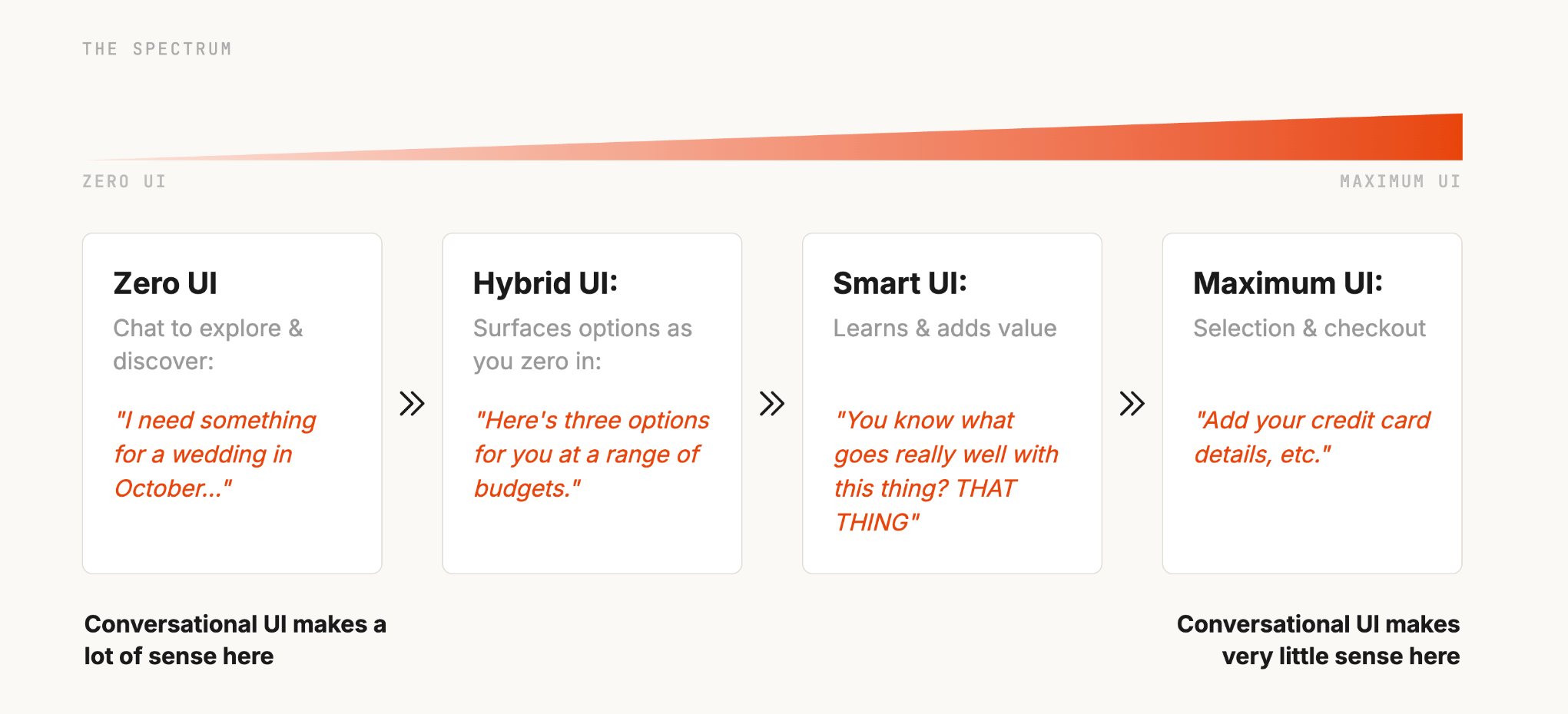
This is the product space Fin for Ecommerce is currently exploring: how to create a perfect shopping experience that blends the best of all of the above modes.
Other more radical futures are also possible. Consumers may start to have their own personal AI Agents that shop on their behalf, meaning people won’t be on your website at all. ChatGPT and Gemini are already surfacing product results – your catalog appearing alongside competitors, a commodity in someone else’s interface.
As this type of shopping becomes more common, the retailers who own a direct, conversational relationship with their customers will have an existential advantage over those still optimizing their grid layout.
Take down the website
Early in the development of Fin for Ecommerce, someone on the team asked: what if you took down the whole ecommerce website and it was just Fin?
That’s not a joke. Almost every UI element on a storefront – product pages, collection pages, category nav, search bars, filters – exists to make a catalog self-navigable. If the default UI was conversational AI, much of that information architecture wouldn’t be necessary.
The storefront as we know it is transitional technology. Our entire interaction model was built for a world where the store couldn’t talk. Now that it can, most of what we built is about to look very, very dated.
The way we process product data is gonna change immense in the next years!