

As we wrap the longest month of the year (both literally and figuratively), let’s take a look back at the ways we’ve changed for the better. The AI age asks a lot of us, it’s worth remembering where we’re going and what’s possible.
Mind the Gap
We’ve all seen the stats, businesses love to say that they’re using AI.
However, “using AI” can mean a lot of different things.
When it comes to implementing AI in customer service, we’ve found that 82% of organizations have invested in the past year and 87% plan to in 2026, according to senior leaders.
But just 10% of teams have implemented it at a deep level.

These frontrunners have reached mature deployment (i.e. AI is fully integrated into their support operations and working at scale) and they are reaping significant benefits. With improving metrics, higher support quality, and a more measurable return on investment, these teams are proving what’s possible and preparing for the future of customer experience.

As Emmet says: “The first passengers are on board and the AI train is leaving the station.”
We surveyed more than 2,400 customer service leaders to understand where we are at this critical moment, where you should be heading, and packaged it into the 2026 Customer Service Transformation Report.
And if you need more convincing, here’s Des’ four key ideas from the report:

Killing the Work Around Work
It’s not just customer service that’s getting an AI makeover.

In the latest edition of Outlier, VP of Product Brian lit up the pages and dropped some knowledge about how AI is shaking up the product world.
The key takeaways:
AI frees up teams to focus on real work. Excessive documentation, roadmapping, and reliance on strict roles can get in the way of shipping updates as soon as possible. Designers can code and engineers can be PMs, the important thing is execution.
With speed to market no longer a competitive edge, there are four ways you can stand out among the crowd:
Create a real product, not consultingware: A product should be able to stand on its own and scale, without lengthy, manual customizations. In AI, that is rare to see, which means customers are reliant upon suppliers and cannot truly own their process for improvement.
A fast feedback loop: With more product judgment you can make the right decisions, at pace.
Quality: Performance is king. A good demo can’t make up for poor day-to-day operations.
Technology stack ownership: Using a model tuned to your specific use case and built on your data can give unmatched performance and efficiency.
Embrace the uncertainty. The winners used to be predictable, now innovation can come from anywhere. That openness is fun.
Catch the full interview here.
Accounting for AI
Not to be outdone, CFO Dan appeared on Run the Numbers with CJ Gustafson to walk all you spreadsheet titans through how AI products are shaking up economics.
Pricing, forecasting, and resource allocation are all up for debate in this new world. Tune in to hear what happens when you tie value to outcomes and the tricky math behind developing an AI product that may cannibalize the product that built your business.
Love seeing the excel-erators on their toes.
Let’s Hear It For The Pioneers
You’ve heard enough from us and our statisticians, now let’s take a look at AI in the wild.
This week, Fin’s best and brightest received their annual 2025 Fin Highlights. Think of it as Spotify Wrapped but instead of “Sad Girl Autumn” we bring you “Total Conversations” and “Resolution Rate”. Could anything be cooler?
It gave support leaders like Ineke a chance to highlight all they’ve achieved with Fin (dubbed Pulsebot at Agorapulse).
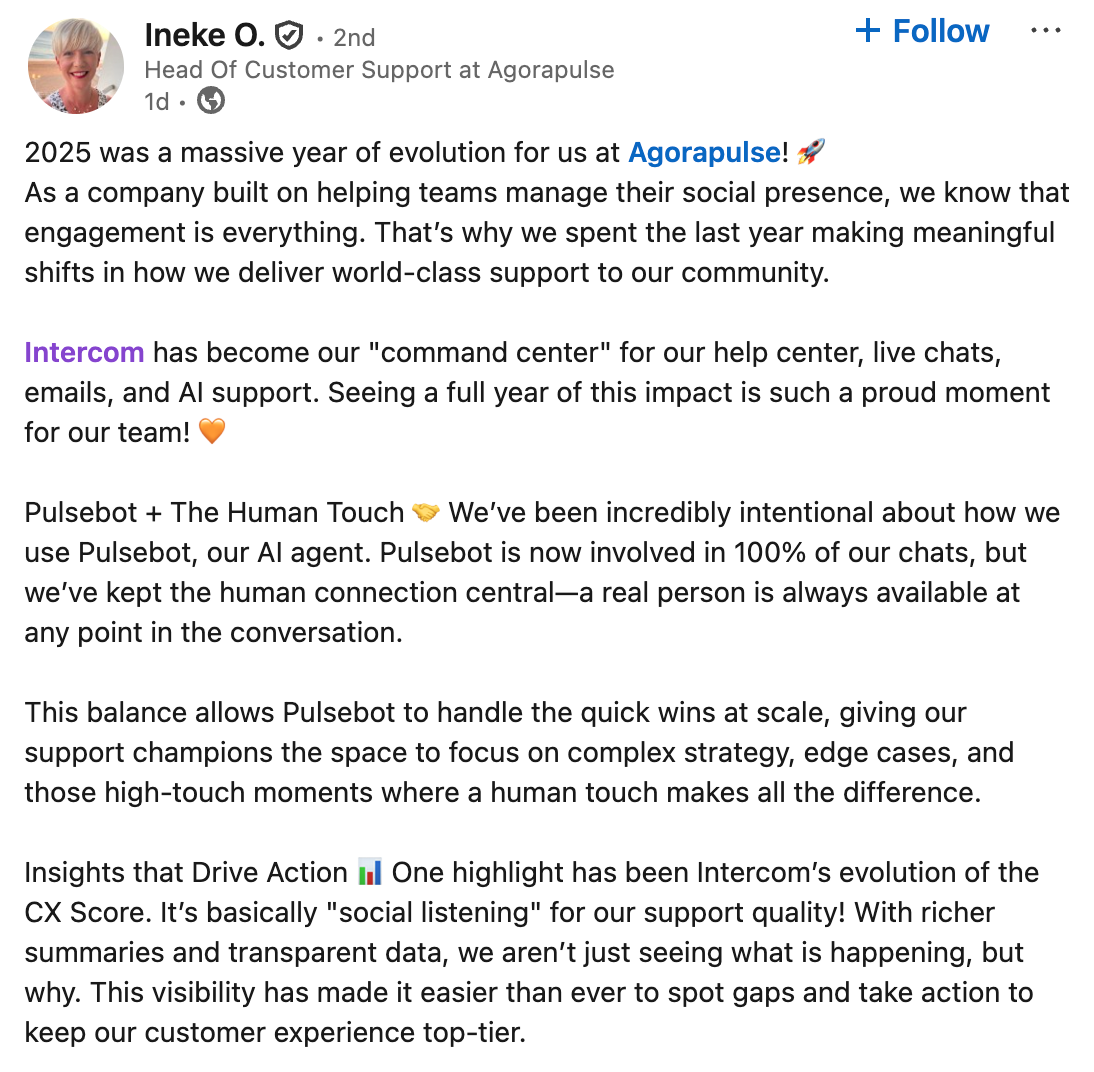
Unified support across channels and the ability to provide high-quality customer experience?
We love to see it.
Here’s Intercom’s own 2025 Fin Highlights:
Our Parting Thought
A lot can happen in a month. Especially when that month is January and AI has you moving at a breakneck pace.
But it’s important to take a step back and admire all you’ve accomplished.
Stay flexible, stay curious, and have fun in the process. You might be surprised what you achieve.
See you next Sunday.