


Today, people use Agents to do tasks – Claude Code can quickly fix that bug that’s been annoying your customers, or OpenClaw can optimize your calendar each day. But increasingly, Agents are also making decisions on our behalf.
If you’re a SaaS business, this means you’re no longer just selling to a CTO or founder, but the Agents they’re using. Ensuring your product is discoverable, configurable, and trustworthy to an Agent is the next product surface worth designing for and prioritizing.
Agents build what they can’t buy
At Intercom, one of our engineering philosophies is to run less software. Don’t build what someone else has already built better.
Agents should work the same way. But they often can’t, because SaaS wasn’t built for them. And as a result, they end up preferring to build instead of buy.
To sign up for most software products, you open a browser, fill in a form, verify an email, and navigate a configuration UI. Sometimes you even have to get on a call with the sales team. That’s fine for humans, but Agents can’t do any of it (yet). So when an Agent needs feature flags, it probably won’t sign up for LaunchDarkly, it’ll build its own feature flag system from scratch.
Agents love to solve problems on their own and they always try their hardest; they’re not always going to ask you to help them navigate a sign-up flow.
The implications of this for providers are best articulated by Aaron Levie, CEO of Box:
“The platforms that are easier for agents to adopt, and solve the agent (and user’s) problems the best, will get ahead far faster than those that don’t. Agents won’t be going to your webinar or seeing your ad; they’re just going to use the best tool for the job, and you’ll want it to be yours.”
We’re already seeing the first wave of providers prioritizing agentic accessibility. When combined with strong brand recognition, they become an Agent’s go-to solution. For example, when setting up payments, Claude almost always picks Stripe. If you need website hosting, it heads to Vercel.
Right now, the financial impacts of Agents’ software preferences are limited. After all, developers are the largest users of coding Agents and they tend to have their own preferences for software and can steer an Agent elsewhere, especially if they’re working in an existing tech stack.
But over time, as Agents become more capable and non-technical users adopt them to set up and run their businesses, an Agent’s choice of software quickly becomes the market’s default choice. Providers hoping to get a leg up in this environment must make SaaS directly consumable by Agents and not assume that an OpenClaw-style browser and email access will provide a quick fix.
What Agent-first means
Since the launch of ChatGPT, there’s been considerable chatter about Answer Engine Optimization (AEO). It’s the LLM counterpart to Search Engine Optimization (SEO). In brief, you optimize your website and content so it will be understood and cited by an LLM. By doing so, you bring organic traffic and potential customers to you. If the LLMs can’t find you, neither can consumers, and it will only get worse as LLMs take on more search volume.
In a similar way, a Command Line Interface (CLI) is the Agent’s equivalent of easy-to-navigate and appealing UI. It allows Agents to understand and use your product. The better your CLI, the more likely it is that an Agent will choose your product when building. Some providers opt to use a Model Context Protocol (MCP), which functions like a wrapper around an API, but CLIs can take on tasks with multiple steps and help Agents get more done.


Creating a CLI is step one of preparing for the Agent-first future, but step two is having a product that can function out-of-the-box. Not “easy to sign up for” – actually deployable by a non-human without any engineering help.
That’s a much larger product issue, not just an interface one. You can’t wrap a CLI around a product that needs hand-tuning. Agents will hit a wall and look for something else or deliver a disappointing experience to users. This grants a considerable advantage to SaaS providers that are already self-configurable and places pressure upon those that are not.
What we built
I’d been watching the rise of agentic software preferences for a while – talking about it on Slack, posting about it, generally making noise. Jordan eventually told me to stop complaining and actually build something. So we did.
The Fin CLI is built for Agents and can be launched by a single prompt. It signs up to Intercom and Fin, configures the Messenger, pulls in your help content, and sets it live. It also returns contextual feedback to the Agent at each step – what to check, what to set up next, and where to go if something isn’t working.
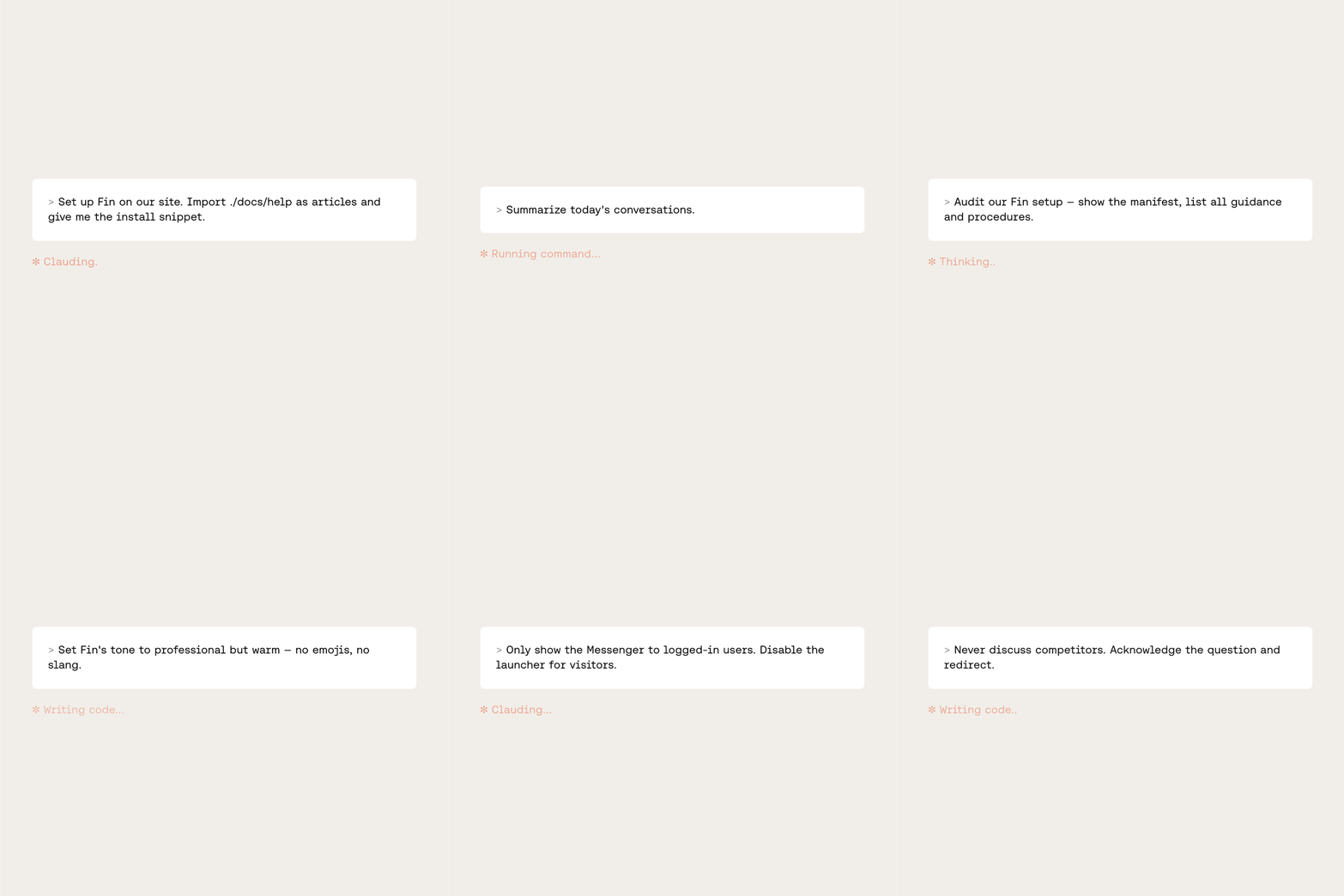
The vision is this: someone asks Claude to build them a product, then says, “I want to talk to my customers and handle support automatically.” Claude says “yes,” and gets Fin up and running all on its own.
AI Agents orchestrating AI Agents. That’s where this goes.
Check out our CLI at fin.ai/cli
