

We know something important about how people approach AI support right now. They’re cautious.
And that’s reasonable. AI support is better than it was, but not universally. There are still poor automated experiences out there. People have been trained, over years, to mistrust automated service. Many of them still type “human” before they’ve even asked their question.
They’re not irrational, they just don’t want to get trapped in an automated loop they can’t escape. They don’t want to feel more frustrated than they already did when they started the conversation.
And they’re arriving in very different emotional states. Some are browsing, some are stressed, some are trying to cancel something, some are trying to get money back, and some are simply confused.
But all of them are making a judgement within seconds.
Customers decide how much to trust the interaction before they read the first answer.
And one of the first things they see is the Agent’s name.
It might seem small, but I’ve discovered it carries more weight than you would expect.
Following curiosity
I recently found myself staring at a spreadsheet with thousands of AI Agent names.
I hadn’t meant to be analyzing anything. I had pulled the data for another project and then, as often happens, I got curious.
I’ve spent the last couple of years talking to companies about their AI Agents. We talk about resolution rates, deflection, CSAT, automation percentages. We talk about what’s working and what isn’t.
What we almost never talk about is what they’ve actually called the thing. And why.
Surely that matters.
And to understand how much, I ran a quick AI analysis.
I soon learned that more than 75% of our customers had opted to name their Agent. And these names followed patterns, creating distinct categories.
The first that caught my attention was “human name.” Some companies used names like Casey, Fiona, Barry. Names that feel familiar, almost intentionally ordinary.
Others lean into product alignment: Nova, Artemis, VectorGPT. The Agent feels like an extension of the platform.
Some go playful: Buddy, ChatCat, Dottie. Those names feel like they carried stories with them – bits of team history or culture that had made their way into the product.
Others strip it back completely: AI Assistant, Operator, Virtual Agent. No personality by design, just extreme clarity.
And then there are the companies who leave the default: Fin. Dozens of them.
None of these are inherently better. But they do signal something to anyone interacting with them.
What’s in a name?
What struck me most wasn’t which names were “good.” It was how differently they clustered depending on context.
When you’re dealing with finance, healthcare, insurance, legal services – anywhere money, personal data or compliance is involved – the names tend to be direct and functional. AI Assistant, Support Bot, Operator. In those environments, reassurance and clarity are most important.
Consumer brands can be more fun. Mascots and human names are favored by ecommerce and lifestyle products, where the emotional tone of the interaction is different.
Tech and SaaS companies often lean product-first. The AI Agent feels like infrastructure rather than personality, integrated into the platform rather than standing beside it.
None of this feels accidental. It feels like companies responding, consciously or not, to the emotional state and expectations of their users.
There’s no global guidebook for how to name your AI Agent. Maybe there shouldn’t be. But even a light look at the data suggests the right choice depends on who your users are, what state they’re in when they arrive, and what your system can realistically deliver.
Vibing it further
Using my findings, I did what anyone with too much curiosity and access to Lovable would do – I built a small tool.
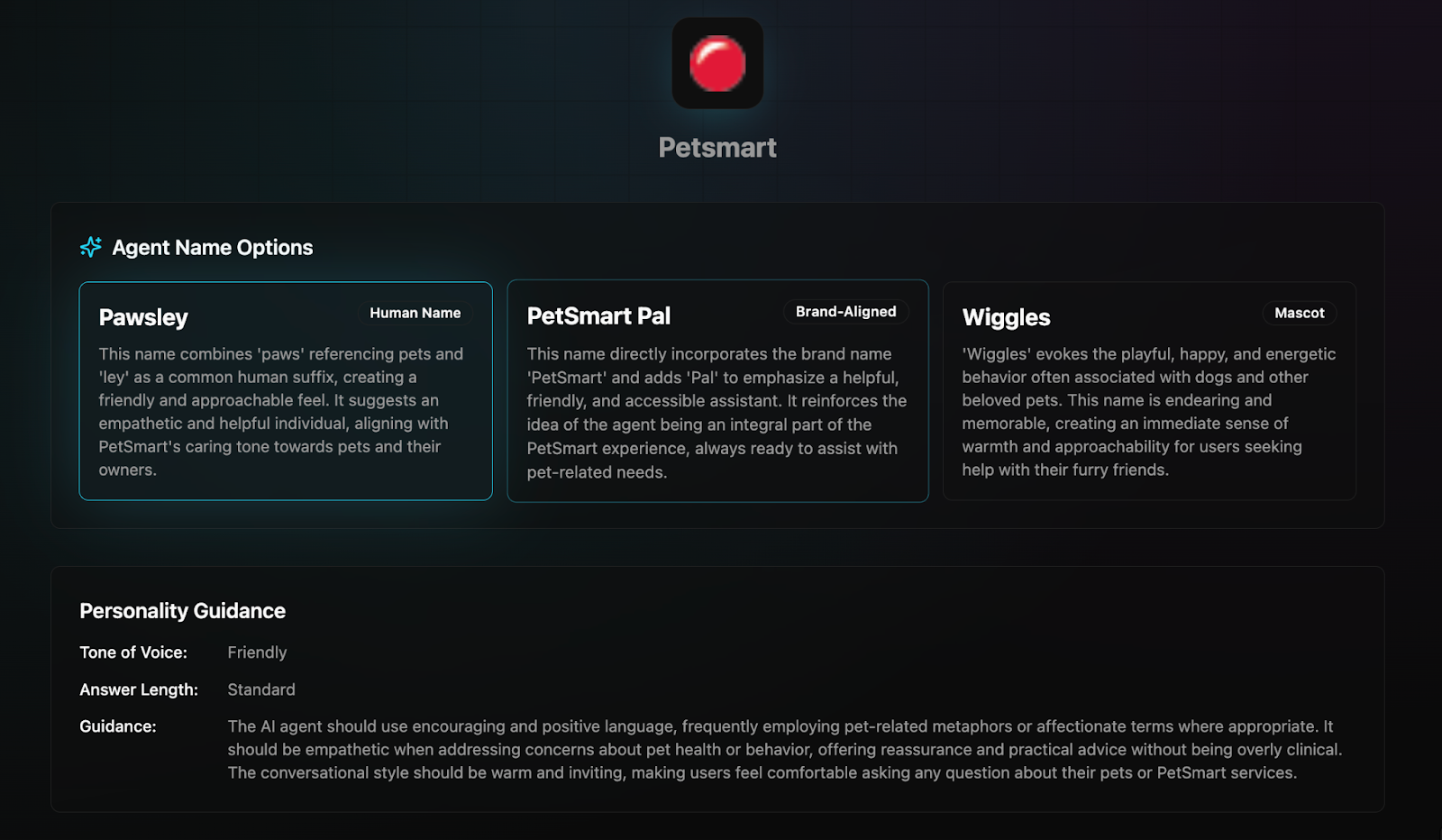
While it’s not scientific or authoritative, it is a way to explore different identity directions for your brand. Just pop in your website, and it suggests names across a few categories – human, product-aligned, mascot.
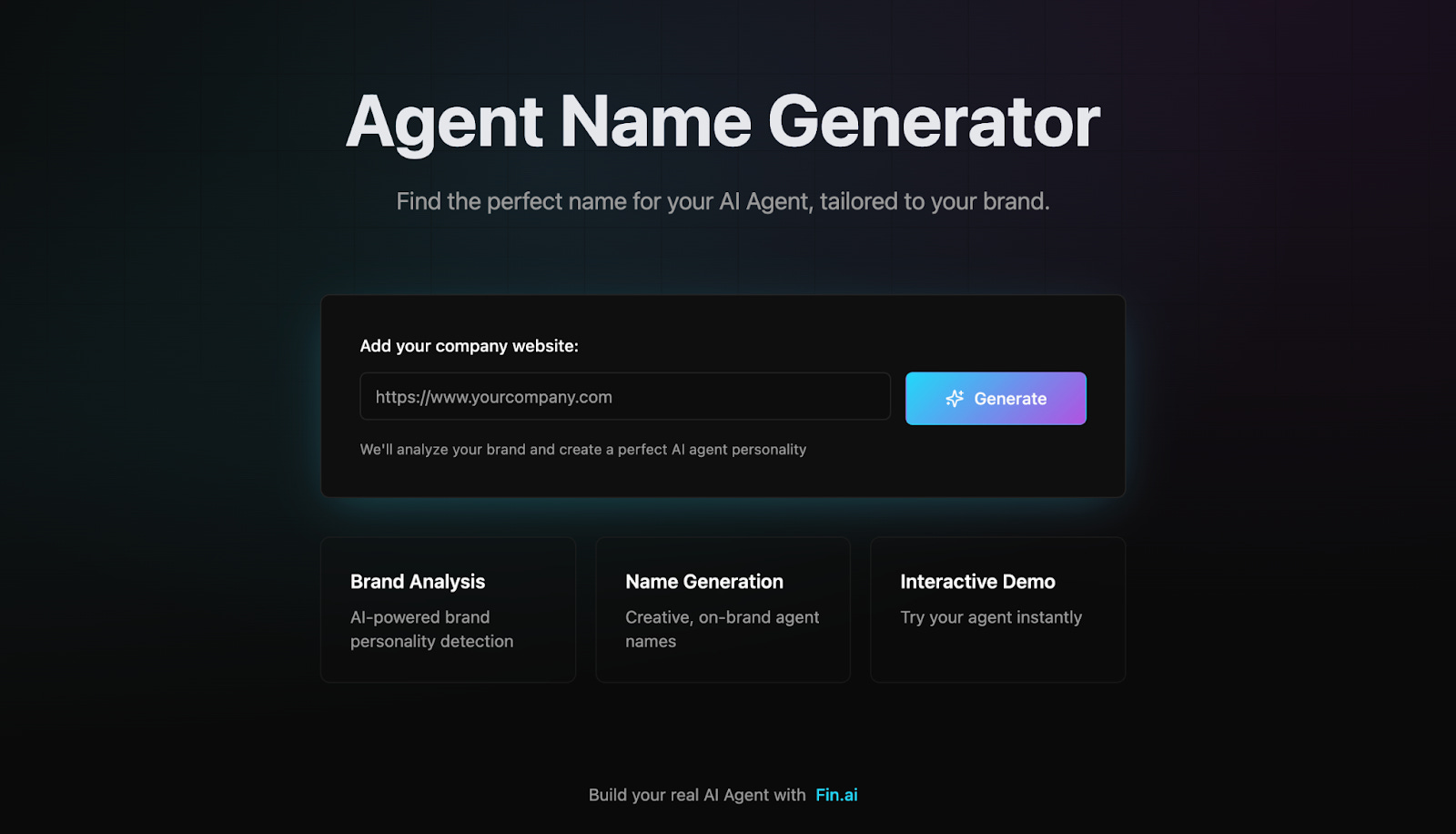
It’s surprisingly helpful to see options outside your instinctive lane.
I also passed my observations on to the Research and Data (RAD) team at Intercom, who can take my analysis to the next level.
AI is great for quick explorations, but more finite conclusions could only be drawn with the help of a human data scientist. For example, a financial company naming their Agent “Penny” could fit into either the “human name” or the “playful name” category. Sorting out this ambiguity is best left to the professionals.
Building trust from the beginning
We’re in a strange in-between moment with AI support. The technology has moved quickly, but trust hasn’t caught up everywhere.
If customers are arriving half-sceptical, then small signals, like a name, can make a difference.
It’s easy to treat that decision as cosmetic. It isn’t.
Because by the time your AI has responded, your customer has already decided what kind of system they think they’re talking to.

Love the perspectives here Kate. It is intriguing the range of ways that companies are choosing to brand their AI Agent. As you point out it is almost always very intentional to ensure that customer engagement with an AI agent reflects a company's brand or is deliberately creating an aura that aligns with customer expectations. All this helps build up trust in AI.